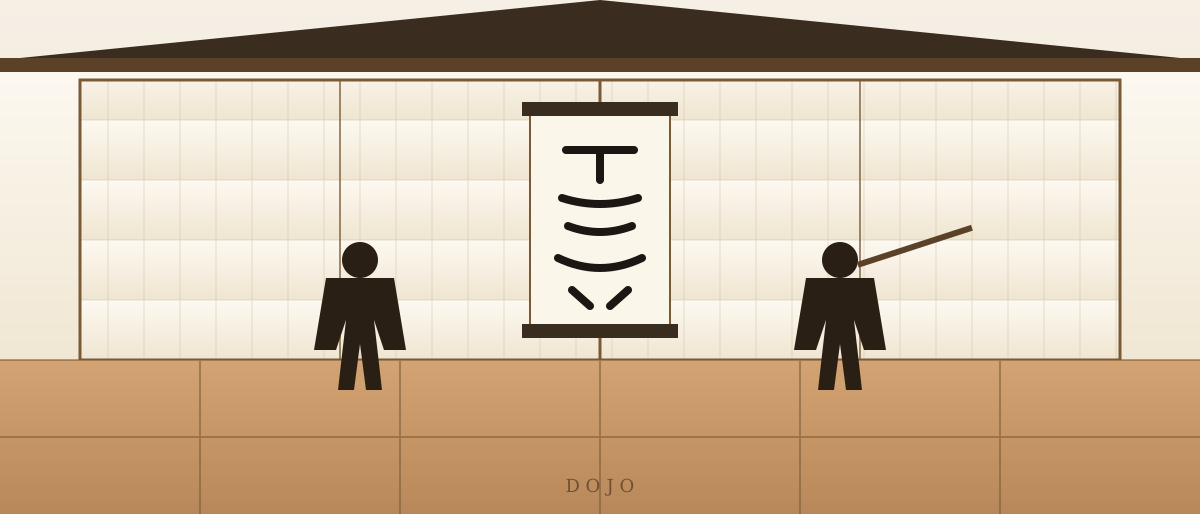
Aikido (合気道) is a modern Japanese martial art founded by Morihei Ueshiba (1883–1969). Its name — built on three kanji, 合 (ai, harmony), 気 (ki, energy) and 道 (dō, way) — translates as "the way of harmonising energy". The practice is non-competitive: training happens in pairs, with the roles of tori (the one performing the technique) and uke (the one receiving it) alternating, and the declared goal is to neutralise the attack through control and projection rather than damage.
History and founding
Morihei Ueshiba, known as O-Sensei, built his system on the Daito-ryu Aiki-jujutsu he learned from Sokaku Takeda, adding insights from kenjutsu, Yagyu jujutsu and the spirituality of the Ōmoto-kyō religion. The name "aikido" was officially adopted in 1942. After the war Ueshiba moved to Iwama, where he refined the forms of the modern art. The world headquarters of the main line is the Aikikai Foundation Hombu Dōjō in Tokyo, today led by the third Doshu Moriteru Ueshiba, the founder's grandson.
Principles and training
A handful of recurring principles drive the practice: using the attacker's force instead of opposing it head-on, circular movement (irimi, tenkan) to step off the line of attack, keeping the centre (hara), coordinating breath and movement. Training takes place standing (tachi-waza), kneeling (suwari-waza), and in a mixed posture (hanmi-handachi-waza). Empty-hand work is paired with the use of the bokken (wooden sword), the jō (staff) and the tanto (wooden knife). No competitions: progress is judged only at formal grading.
Styles and lineages
Since the founding, several distinct technical lineages have developed from Ueshiba's teaching, traceable to his senior students:
- Aikikai: the direct line of the Ueshiba family, represented today by the Aikikai Hombu Dōjō in Tokyo; it is the most widespread lineage worldwide.
- Iwama-ryū / Takemusu Aiki: from Morihiro Saito's teaching, with strong emphasis on the integration of empty-hand work and weapons.
- Yoshinkan: from Gozo Shioda, a pre-war student of Ueshiba; a more martial, standardised style.
- Shin Shin Toitsu Aikido (Ki Society): from Koichi Tohei, focused on unifying mind and ki.
- Shōdōkan (Tomiki): from Kenji Tomiki, the only school with a codified competition system.
Ranks and progression
Aikido uses the Japanese kyu/dan system. Kyu grades (usually from 6th to 1st) form the pre-black-belt path, with white or coloured belts depending on the lineage. Dan grades start at shodan (1st dan) and reach 8th dan in the Aikikai lines. Progression is governed by minimum tatami days and by passing technical exams. Seminars are usually open to all ranks; some residential events leading up to dan exams require a minimum grade to attend.
How to pick a seminar
- Required level: open to all or restricted by a minimum rank stated on the announcement.
- Type of practice: empty-hand only (tachi-waza), weapons (bokken, jō, tanto), or themed seminars (kihon, henka-waza, jiyu-waza).
- Instructor's lineage: programmes and technical vocabulary differ between Aikikai, Iwama, Yoshinkan, Ki Society and Shōdōkan.
- Length: single day, weekend, or summer residential camp (3–5 days).
- Grading validity: some events count towards dan exam requirements; not all seminars do.
Frequently asked questions
- Does aikido have competitions?
- In the main lineages (Aikikai, Iwama, Yoshinkan, Ki Society) no: practice is non-competitive and progress is judged at formal grading only. The only school with a codified competition system is Shōdōkan, of the Tomiki line.
- Which style or lineage should I pick?
- For a beginner the quality of the local teacher and dōjō matters more than the abstract choice of style. Aikikai is the most widespread lineage and therefore the easiest to find; the others (Iwama, Yoshinkan, Ki Society, Shōdōkan) have distinct technical identities and their own reference dōjō.
- Can I attend a seminar as a beginner?
- Yes, unless the announcement says otherwise. Most gatherings split into groups by rank.
- Do I need any special equipment?
- A keiko-gi (white judogi) is required; the hakama, black or blue, is usually worn from 1st kyu or 1st dan depending on the lineage. Weapons seminars require bokken, jō and possibly tanto.
- How long does a seminar typically last?
- Weekend (Saturday afternoon and Sunday morning) and summer residential camps (3–5 days) are the most common formats. Single-day clinics and multi-week international events at the highest grades also exist.
Further reading:Aikikai Foundation Hombu Dōjō (Tokyo)International Aikido Federation (IAF)